
TL;DR:
- Movement-based activities like Cuban salsa foster genuine connection and reduce social anxiety.
- Cuban salsa’s structure allows rapid interaction across diverse groups, unlike traditional icebreakers.
- Incorporating salsa into events creates memorable, inclusive experiences that encourage natural engagement.
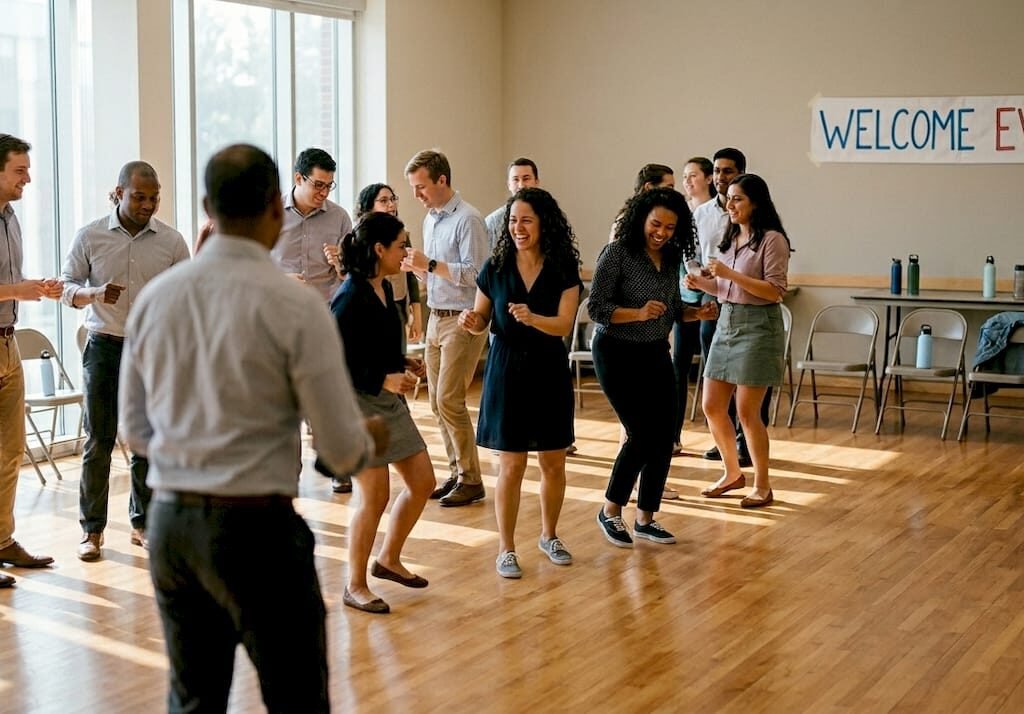
Most icebreakers fail before they even start. Someone hands out a worksheet, asks everyone to share a fun fact, and the room fills with polite smiles and quiet dread. The problem is not the people. It is the format. Forced conversation creates pressure, and pressure kills connection. Cuban salsa does the opposite. It pulls people onto the floor, wraps them in rhythm, and lets the music do the talking. In this article, you will learn why salsa works as a social catalyst, how it compares to traditional icebreakers, and how you can bring it to your next event in Wrocław.
Key Takeaways
| Point | Details |
|---|---|
| Movement connects people | Salsa uses music and motion to naturally break down social barriers at events. |
| No experience required | Anyone can join a salsa icebreaker, regardless of age or dance background. |
| Strangers become friends | Cuban salsa helps guests interact and build real connections from the very start. |
| Fits any event | Salsa icebreakers work equally well for corporate functions, weddings, and private parties. |
The social science behind icebreakers that work
An icebreaker is any activity designed to help strangers feel comfortable around each other. In theory, it sounds simple. In practice, most icebreakers create exactly the kind of self-consciousness they are meant to dissolve. People worry about saying the wrong thing, appearing boring, or standing out in an uncomfortable way.
The core issue is that most traditional icebreakers rely on verbal performance. You are asked to speak, to be witty, or to reveal something personal in front of people you just met. That is a high-stakes situation for many guests, especially introverts or people attending cross-cultural events.
Psychology offers a better path. Shared experiences and nonverbal communication are among the most effective ways to build genuine connection. When people move together, laugh together, and respond to the same music, they form bonds that conversation alone rarely achieves in the same timeframe.
This is exactly where Cuban salsa shines. It is built on nonverbal cues: eye contact, rhythm, physical coordination, and shared laughter when someone misses a step. Nobody needs to be funny or clever. The dance itself carries the social load.
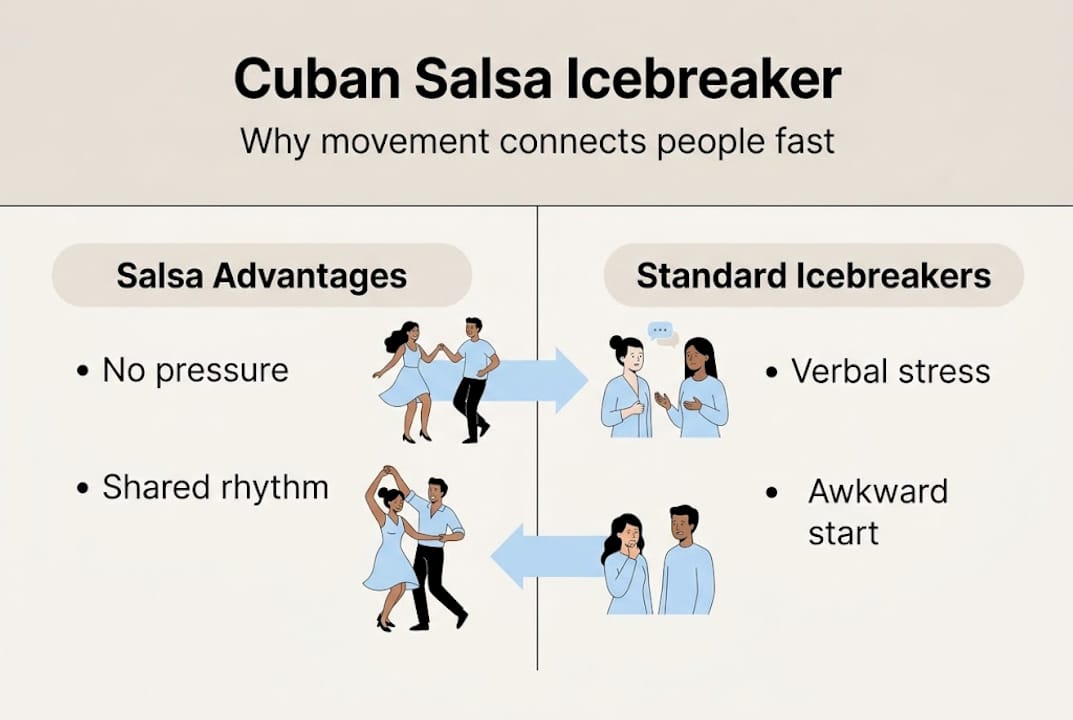
Here is a quick look at what separates effective icebreakers from ineffective ones:
| Factor | Ineffective icebreakers | Effective icebreakers |
|---|---|---|
| Requires verbal performance | Yes | No |
| Encourages nonverbal bonding | Rarely | Yes |
| Works across cultures | Limited | Yes |
| Creates shared memory | Unlikely | Yes |
| Lowers anxiety through movement | No | Yes |
What makes salsa particularly powerful is its structure. You are not just moving randomly. You are learning something together, which creates a sense of shared progress. That feeling of “we figured this out” is a fast track to group cohesion.
Key reasons movement-based icebreakers outperform talk-based ones:
- Movement releases endorphins, which naturally lift mood and reduce social anxiety
- Rhythm synchronizes groups, creating a subconscious sense of unity
- Physical activity shifts focus outward, reducing self-consciousness
- Laughter during dance is spontaneous and genuine, not performed
- Partner rotation ensures everyone interacts, not just familiar clusters
Pro Tip: If you want guests to connect quickly, give them something to do together rather than something to say. The power of Latin dance events lies precisely in this shift from talking to experiencing.
How Cuban salsa transforms strangers into friends
Knowing the science is one thing. Seeing it happen in a room full of strangers is another. Cuban salsa has a specific structure that makes social connection almost inevitable.
Unlike linear salsa styles, Cuban salsa is circular and group-friendly. It is often taught in rueda de casino format, where dancers form a circle and rotate partners on cue. This means that within 15 minutes, a guest who arrived knowing no one has physically interacted with a dozen people. That is not something any name-tag game can replicate.
Here is how the transformation typically unfolds at an event:
- Guests arrive and observe. The music is playing, instructors are warming up, and curiosity replaces hesitation.
- A short, simple lesson begins. No experience is needed. The first steps take about two minutes to learn.
- Partner rotation starts. Guests swap partners every few minutes, spreading energy and laughter across the room.
- Shared humor kicks in. Missed steps become inside jokes. People cheer each other on.
- The music takes over. By this point, guests are no longer thinking about the icebreaker. They are just dancing.
- The energy carries into the rest of the event. Conversations flow naturally because the tension is already gone.
As research confirms, partner dancing crosses group boundaries in ways that seated activities simply cannot. People who would never approach each other at a cocktail hour end up laughing together on the dance floor.
“Dance removes the social scripts we usually rely on. When you are focused on the rhythm, you stop performing and start connecting.” — Dance psychology researcher
This works across ages, backgrounds, and languages. A 60-year-old executive and a 25-year-old intern can share a genuine moment over a missed spin. That kind of cross-group connection is rare and valuable, whether you are planning salsa for team building or a wedding reception. And when guests see a professional show midway through the evening, the energy doubles. You can transform your event with salsa shows that inspire even the shyest guests to join in.
Cuban salsa vs. traditional icebreakers: A side-by-side comparison
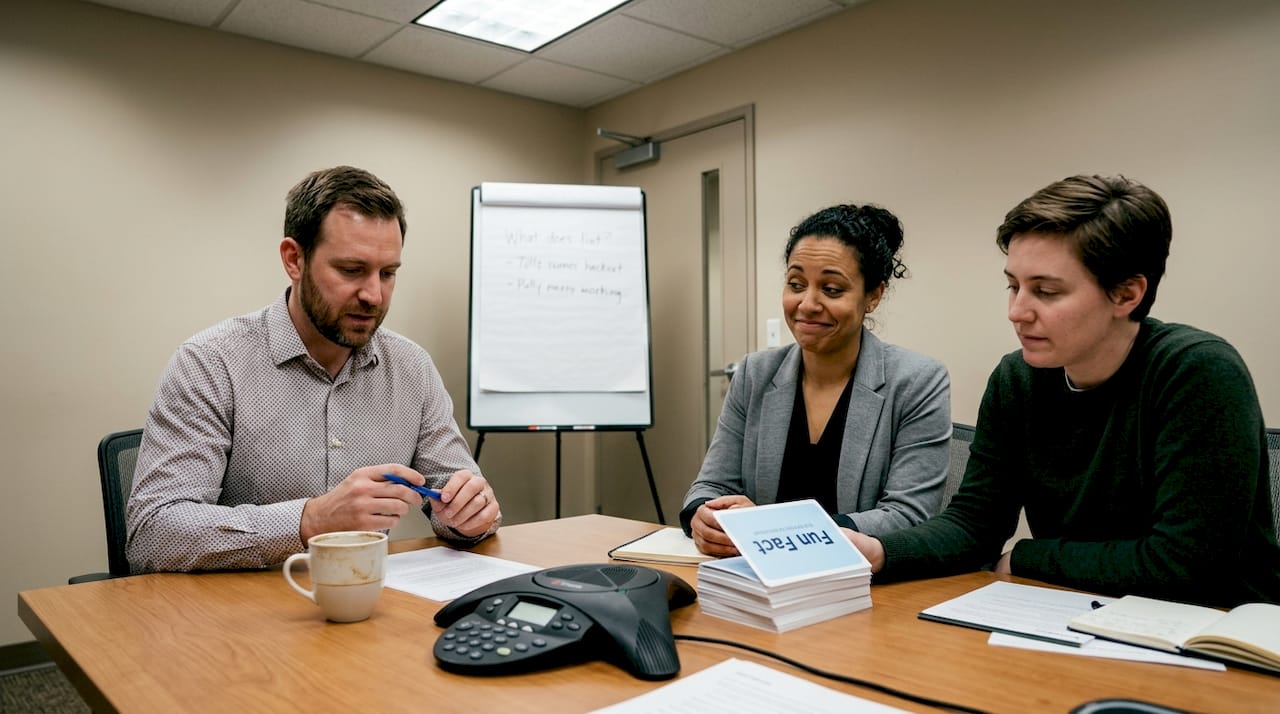
Let’s be direct. Most event planners default to the same handful of icebreakers: two truths and a lie, trivia games, or speed networking rounds. These formats have their place, but they carry real limitations.
Traditional icebreakers often create a performance dynamic. Someone has to be interesting enough, funny enough, or quick enough to win the room’s approval. For introverts, non-native speakers, or guests who simply do not enjoy public speaking, these formats are stressful rather than welcoming.
Cuban salsa flips the script entirely. Physical activity at events lowers barriers between participants and enhances mood in ways that verbal games cannot. The playing field is level because everyone is a beginner. Nobody has a home-court advantage.
| Category | Traditional icebreakers | Cuban salsa |
|---|---|---|
| Language required | Yes | No |
| Anxiety level | Medium to high | Low |
| Fun factor | Moderate | High |
| Participation rate | Selective | Near universal |
| Lasting memory created | Rarely | Almost always |
| Works for mixed cultures | Inconsistently | Yes |
| Physical engagement | None | Full |
What makes Cuban salsa uniquely suited as an icebreaker:
- No language skills needed, making it ideal for international or multicultural events
- Beginners and experienced dancers can participate side by side without awkwardness
- The instructor guides the group, removing the pressure from any single guest
- Music sets an instant emotional tone that games and worksheets cannot replicate
- It creates a shared story guests talk about long after the event ends
For event planners looking to go beyond the usual format, exploring Latin dance event ideas opens up a wide range of options. And if you are new to the style, understanding Cuban salsa’s event magic will help you see why it consistently outperforms other social activities.
Bringing salsa icebreakers to life in Wrocław events
Planning a salsa icebreaker does not require a ballroom or professional dancers in your guest list. What it does require is a little structure and the right support.
For weddings in Wrocław, a 20-minute salsa lesson before the main reception works beautifully. Guests arrive, get introduced to a few basic steps, and by the time dinner is served, they already feel like old friends. The energy carries through the entire evening.
For corporate events, salsa icebreakers work especially well at the start of a conference or team gathering. They signal immediately that this event will be different. Colleagues who only interact over email suddenly share a laugh over a missed clave beat, and that moment of humanity matters.
For private parties and birthday celebrations, a salsa circle is a crowd-pleaser across generations. Grandparents and teenagers can participate equally, which is rare for any group activity.
Best practices for introducing salsa at your event:
- Keep the intro lesson short, around 10 to 15 minutes, to maintain energy
- Use a live DJ or curated playlist with authentic Cuban rhythms for maximum atmosphere
- Have the instructor demonstrate first, then invite guests rather than pulling them up
- Offer a “watching zone” so hesitant guests feel included without pressure
- Plan partner rotations to ensure cross-group mixing, not just friend clusters
As event professionals note, Cuban salsa highlights guests of all ages at weddings and corporate parties, making it one of the most versatile entertainment formats available.
Pro Tip: Hiring a professional instructor makes a significant difference. Guests follow a confident lead, and the instructor can read the room and adjust the pace. For curated salsa entertainment ideas and a fully guided unforgettable salsa dance experience in Wrocław, working with specialists removes all the guesswork.
Why Cuban salsa breaks the ice in ways conversation never can
Here is something most event planning guides will not tell you: conversation is actually a terrible icebreaker for most people. It rewards extroverts, punishes introverts, and creates invisible hierarchies based on who is the most entertaining in the room.
Cuban salsa does none of that. It gives everyone the same starting point: zero experience, one beat, and a partner who is just as uncertain as you are. That shared vulnerability is more powerful than any scripted question.
We have seen this happen at events across Wrocław. A group of colleagues who barely spoke at the office were laughing and high-fiving within ten minutes of stepping onto the dance floor. The music did not just set the mood. It removed the social armor people wear in professional settings.
The rhythm of Cuban salsa also creates something called entrainment, where people’s movements and even heartbeats begin to synchronize. That is not a metaphor. It is a measurable physical response that builds genuine feelings of closeness. Authentic Cuban dance experiences tap into this naturally, without anyone needing to try.
For event planners, the takeaway is simple: stop asking guests to perform. Give them something to feel instead.
Plan your next unforgettable event with Cuban salsa
If you are organizing a wedding, corporate gathering, or private party in Wrocław and want guests to genuinely connect, Cuban salsa is the most reliable tool available. It requires no prior experience, works across all age groups, and leaves people with memories they actually talk about.
Castillo Salsa specializes in exactly this kind of experience. Whether you want a short icebreaker workshop, a full evening of Cuban salsa for events, or a structured Cuban salsa party workflow tailored to your guest list, the team brings the energy, the expertise, and the music. Explore the full range of salsa entertainment ideas and find the format that fits your event perfectly.
Frequently asked questions
What makes Cuban salsa an effective icebreaker at events?
Cuban salsa gets everyone moving and laughing together without the pressure of verbal performance. As research shows, partner dancing crosses group boundaries in ways that seated activities cannot, making connection feel natural rather than forced.
Can people with no dance experience join a salsa icebreaker?
Absolutely. Cuban salsa is structured for beginners and designed so that guests of all experience levels can participate from the first minute. Salsa is inclusive and accessible to anyone willing to step onto the floor.
How long does a typical salsa icebreaker segment last at an event?
Most salsa icebreakers run about 20 to 30 minutes, which is enough time to set a relaxed, energetic tone without taking over the event schedule.
Is salsa suitable as an icebreaker for both corporate and private events?
Yes. Cuban salsa highlights guests of all ages at weddings, birthday parties, and corporate team gatherings, making it one of the most versatile social activities available for any event format.
